

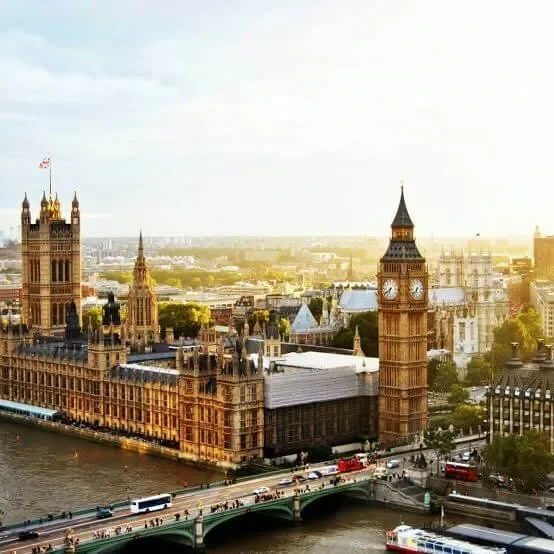
If you only have time for three classic London sights, make them the London Eye, Westminster Abbey and Big Ben. They sit within a short walk of each other along the Thames, so you can see all three in a single day: the Eye for the skyline, the Abbey for a thousand years of history, and Big Ben for the city’s most famous silhouette.
London’s red buses, Underground and riverside walks make it easy to get around, and this corner of the city, between the South Bank and Westminster, is the perfect place for a first visit to start.
Your Route Through This Guide
- Three Landmarks Compared
- Module 1: The London Eye
- Module 2: Westminster Abbey
- Module 3: Big Ben and the Elizabeth Tower
- Questions First-Time Visitors Ask
Three Landmarks Compared
Use this snapshot to decide how to split your day.
| Landmark | Best for | Time needed | Good to know |
|---|---|---|---|
| London Eye | Panoramic views, first-timers, families | About 30 minutes on the wheel, plus queueing | Book timed tickets online; clear days give the best views |
| Westminster Abbey | History, architecture, literature lovers | Two to three hours | A working church: dress respectfully and check opening times |
| Big Ben | Photos, Gothic architecture, the famous chimes | Short stop outside; longer for tower tours | Tower tours are limited and need advance booking |
Module 1: The London Eye
The London Eye, originally called the Millennium Wheel, opened to the public in March 2000. It was meant to be temporary, but it quickly became one of the UK’s best-loved landmarks and a permanent part of the skyline on the South Bank.
Design and engineering
Architects David Marks and Julia Barfield drew inspiration from a giant bicycle wheel. The structure uses around 1,700 tonnes of steel and carries 32 sealed, climate-controlled capsules, one for each of London’s boroughs. A full rotation takes roughly 30 minutes, moving slowly enough that passengers usually step on and off while it keeps turning.
What you’ll see
From the top, the view stretches across the Houses of Parliament, St Paul’s Cathedral, the City’s towers and, on a clear day, far beyond central London. The capsules have glass on all sides and room to walk around, so everyone gets a turn at the best angles. Information screens inside each capsule help you identify the landmarks below, and a fast-track ticket can cut waiting time on busy summer weekends.
Making the most of it
Book a timed slot online to avoid long ticket queues, and check the weather forecast: haze and low cloud can hide the distant landmarks. Late afternoon is a popular choice, as you see the city by daylight and then watch the lights come on. The Eye also hosts special light displays and seasonal events, including the New Year’s Eve fireworks, so it’s worth checking what’s on during your trip.
Where you stay shapes how easily you can reach all this. If you’re comparing apartments rather than hotels, it pays to know what to check before booking a holiday rental online, from location to cancellation terms.
Module 2: Westminster Abbey
A short walk across Westminster Bridge brings you to Westminster Abbey, the setting for coronations since 1066, royal weddings and the burials of monarchs, scientists and writers. It’s one of the most important buildings in British history.
Plan ahead
Buy tickets online in advance. You’ll skip much of the queue and gain time to explore at your own pace. Because the Abbey is a working church, it closes to sightseers during some services and on Sundays, when visitors are welcome to attend worship instead. Check the official schedule before you go.
Highlights inside
Take your time through the soaring Gothic nave and the intricate side chapels. Don’t miss Poets’ Corner, where Chaucer is buried and many of Britain’s greatest writers are memorialised. Look for the Coronation Chair, the tombs of Tudor monarchs including Elizabeth I, and the Lady Chapel’s remarkable fan-vaulted ceiling. The multimedia guide, included with entry, brings the stories to life, and verger-led tours offer extra access and insight if you want to go deeper.
Practical tips
Dress respectfully, since it is a place of worship, and wear comfortable shoes; you’ll likely be on your feet for a few hours. Carry a water bottle and allow time for the cloisters and the gift shop, which sells books on British history and locally inspired souvenirs.
Module 3: Big Ben and the Elizabeth Tower
Strictly speaking, Big Ben is the Great Bell inside the clock tower at the north end of the Palace of Westminster. The tower itself was renamed the Elizabeth Tower in 2012 to mark Queen Elizabeth II’s Diamond Jubilee, though almost everyone still calls the whole thing Big Ben.
A troubled beginning
Designed by Augustus Pugin in the Gothic Revival style and completed in 1859, the tower had a difficult start. The first bell cracked during testing, and a replacement was cast; that bell, which itself later developed a crack, is the one that still rings today. The clock mechanism was famously accurate for its era, and its chimes have been broadcast around the world for generations, marking New Year celebrations and national moments of remembrance.
Restored for the future
In 2017 the tower began a major restoration to repair the stonework, refurbish the clock and restore original details, including the dials’ striking Prussian blue and gold. The work finished in 2022, and the bells returned to regular service.
Seeing it up close
The best photo spots are Westminster Bridge, Parliament Square and the South Bank opposite. Tours of the tower itself are available in limited numbers through the UK Parliament website and sell out quickly, so book well ahead if you want to climb the steps and see the clock mechanism.
A simple one-day plan
Arrive at Westminster Abbey when it opens, while crowds are lighter, and spend the morning inside. Step out to Parliament Square for photos of the Elizabeth Tower, then grab lunch nearby or along the river. In the afternoon, walk across Westminster Bridge to the South Bank for your London Eye slot. Afterwards, stroll east along the riverside past street performers, bookstalls and cafés towards the Southbank Centre. If you still have energy, an evening river cruise from Westminster Pier shows all three landmarks lit up from the water. Pace yourself: the distances are short, but the crowds around Westminster can be heavy in summer and during school holidays, so allow extra time and keep valuables secure in busy spots.
Questions First-Time Visitors Ask
Can I visit all three in one day?
Yes. They’re within about fifteen minutes’ walk of each other. Start at the Abbey in the morning, see Big Ben, then cross the bridge for the London Eye in the afternoon.
Do I need to book in advance?
It’s strongly recommended for the London Eye and Westminster Abbey, and essential for Elizabeth Tower tours, which have very limited places.
What’s the nearest Tube station?
Westminster station serves all three. Waterloo is also close to the London Eye on the South Bank.